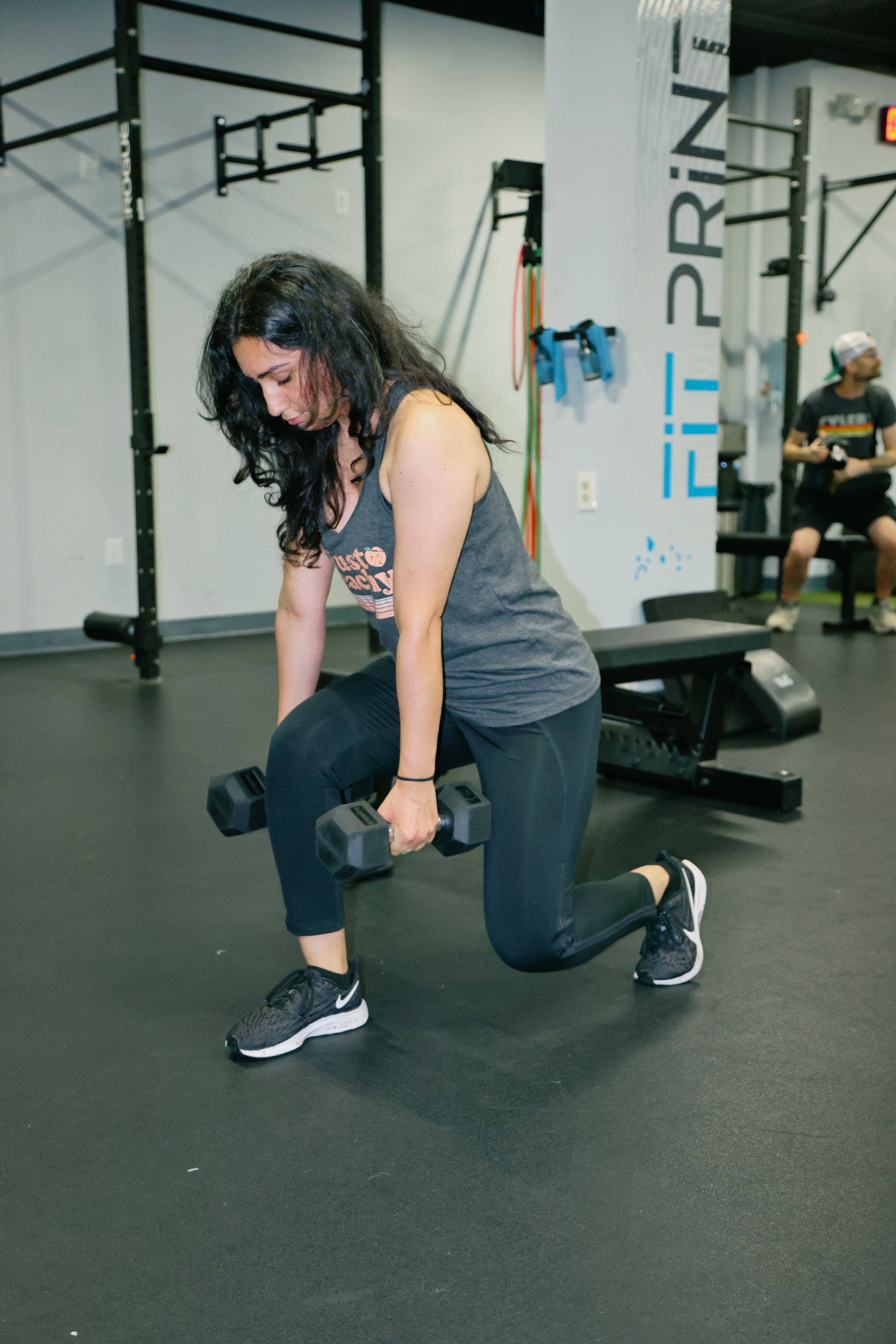
You do not need a full gym setup to train your legs effectively.
A pair of dumbbells can add resistance to squats, lunges, Romanian deadlifts and other lower-body exercises without requiring large machines or a barbell.
The right exercise selection can target your quads, hamstrings, glutes and calves in a relatively small space.
01
Goblet squat
Hold one dumbbell vertically against your chest.
Stand with your feet around shoulder-width apart and lower your hips while keeping your torso controlled.
Push through your feet to return to standing.
Goblet squats are easy to set up and work particularly well when you have one heavier dumbbell.
02
Dumbbell Romanian deadlift
Hold a dumbbell in each hand in front of your thighs.
Keep a slight bend in your knees and push your hips backward while lowering the weights.
Stop when you feel tension through the hamstrings, then drive your hips forward to stand.
The movement should come primarily from the hips rather than from squatting downward.
03
Dumbbell reverse lunge
Hold one dumbbell in each hand.
Step one leg backward and lower until both knees are comfortably bent.
Push through the front foot to return to the starting position.
Reverse lunges can feel easier to control than forward lunges because the front foot remains planted.
04
Bulgarian split squat
Stand a short distance in front of a bench or stable elevated surface.
Place one foot behind you and lower the rear knee while keeping most of your working pressure through the front leg.
Holding dumbbells increases resistance significantly.
Start light because balance can be challenging.
05
Dumbbell step-ups
Use a stable box, bench or step.
Hold dumbbells by your sides, place one foot on the elevated surface and drive through that leg to stand.
Control the descent rather than dropping quickly back to the floor.
06
Dumbbell sumo squat
Take a wider stance than a standard squat and point your feet slightly outward.
Hold one dumbbell vertically between your legs.
Lower under control and stand back up.
This variation changes the stance and can place greater emphasis on the inner thighs and glutes.
07
Standing calf raises
Hold dumbbells at your sides.
Rise onto the balls of your feet, pause briefly and lower slowly.
You can also perform the exercise one leg at a time for more resistance without needing heavier dumbbells.
08
How heavy should your dumbbells be?
Choose a weight that lets you maintain good technique throughout the set.
The final repetitions should feel challenging without forcing you to lose control of the movement.
Adjustable dumbbells are particularly practical at home because different leg exercises may require very different weights.
You can compare options in our guide to the best dumbbells.
09
Practical checks before you continue
Begin with a load that lets you control every repetition and keep two or three technically sound repetitions in reserve. A chair or wall can provide balance while learning split squats and lunges. Stop a set when posture changes rather than chasing a fixed number.
Build a simple session around one squat, one hip hinge and one single-leg pattern, then add calf raises if useful. Our guide to the best dumbbells can help match handle style and increments to a small training space.
Progress by adding a repetition, slowing the lowering phase, increasing range of motion or choosing a slightly heavier dumbbell. Change one factor at a time. Adjustable equipment makes small increases easier; compare options in our adjustable dumbbell guide.
Allow recovery between demanding leg sessions and keep a written record of sets, repetitions and load. Pain is not a normal progression signal. If you have an injury, balance concern or medical limitation, seek advice from a qualified professional before starting a new program.
A stable floor and clear space matter as much as weight. Keep pets, furniture and loose mats outside the movement area, and wear footwear that gives you dependable contact. For compact equipment choices, see adjustable dumbbells for home workouts.
Sources and further reading
We use primary and specialist sources to check the principles in this article. Product recommendations are researched separately.
