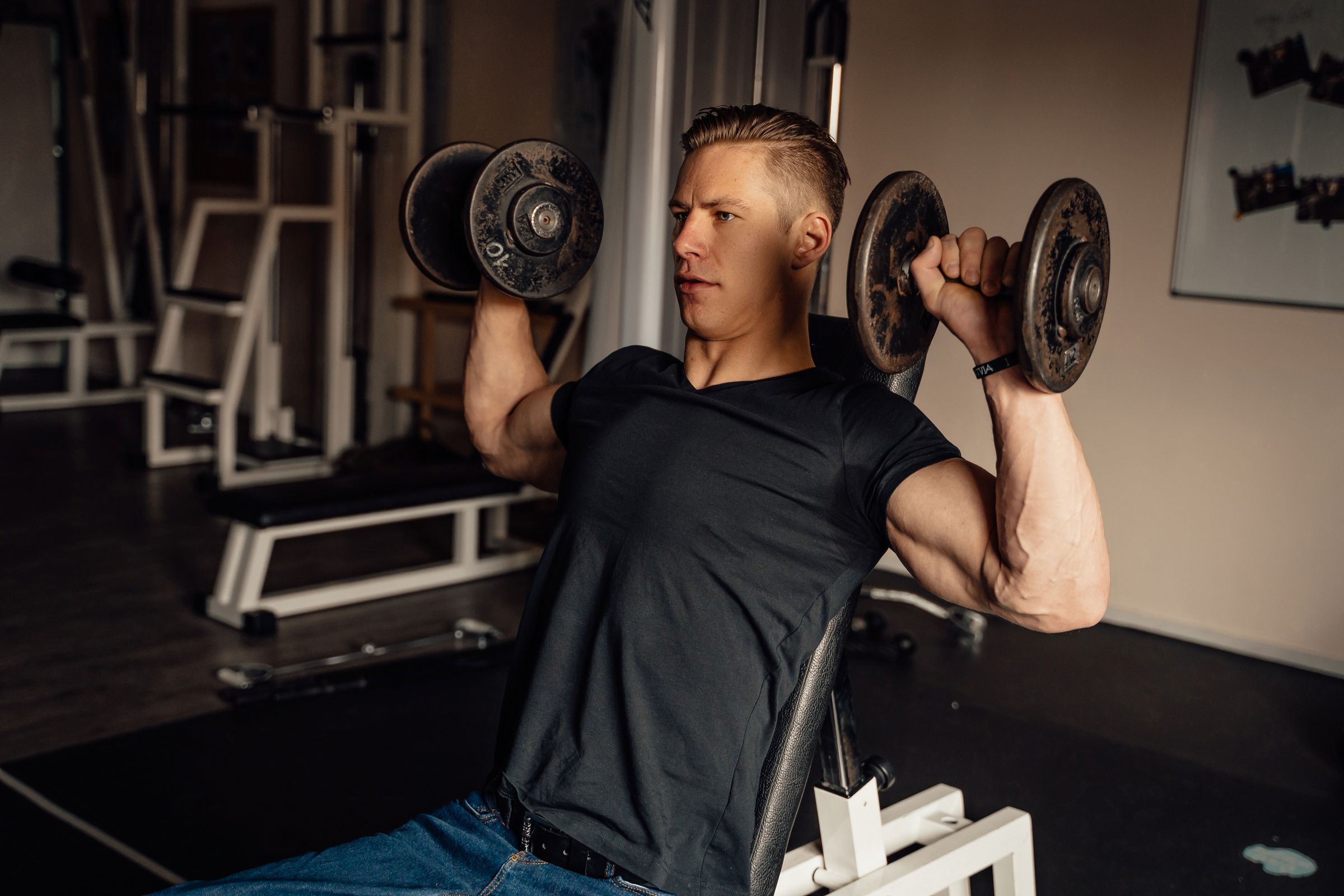
Dumbbells are particularly useful for shoulder training because each arm works independently and the weights allow a wide range of movement.
You can target the front, side and rear portions of the shoulders using only a few basic exercises.
Good technique matters more than using the heaviest possible weight.
01
Dumbbell shoulder press
Hold a dumbbell in each hand around shoulder height.
Press the weights upward until your arms are extended, then lower them under control.
The exercise can be performed standing or seated.
Avoid excessively arching your lower back to move heavier weights.
02
Dumbbell lateral raise
Hold light dumbbells by your sides.
Raise your arms outward until they are roughly around shoulder level, keeping a slight bend in your elbows.
Lower slowly.
Lateral raises usually require much lighter weights than pressing movements.
Using momentum can reduce control and shift tension away from the shoulders.
03
Dumbbell front raise
Hold the dumbbells in front of your thighs.
Raise one or both arms forward until around shoulder height, then lower under control.
The front deltoids already work heavily during pressing movements, so front raises may not be necessary in every program.
04
Rear delt fly
Lean forward at the hips while keeping your back controlled.
With a dumbbell in each hand, move your arms outward until you feel the rear shoulders working.
Use relatively light weights.
This exercise helps train the rear deltoids, which can receive less attention than the front and side portions of the shoulder.
05
Arnold press
Start with the dumbbells in front of your face, palms facing inward.
As you press overhead, rotate your hands outward.
Reverse the movement on the way down.
The Arnold press uses a longer movement path than a standard shoulder press.
06
Single-arm shoulder press
Pressing one dumbbell at a time can help you focus on each side independently.
It also increases the demand on your torso to resist leaning.
This is useful if you only have one heavy dumbbell available.
07
How much weight should you use?
Use heavier weights for presses and lighter weights for raises.
Your shoulder joint moves through a large range of motion, so forcing very heavy dumbbells through isolation exercises is rarely necessary.
Control each repetition.
If you train at home, adjustable dumbbells make it easier to switch between heavy presses and lighter raises.
08
How many exercises do you need?
Two to four shoulder exercises can be enough for a focused workout.
A simple combination could include:
- shoulder press
- lateral raise
- rear delt fly
That covers multiple portions of the shoulder without making the session unnecessarily complex.
09
Practical checks before you continue
The shoulder moves through several planes, so a balanced session can combine a press with controlled lateral and rear-delt work. You do not need a heavy load for every movement. Raises usually require much less weight than presses to remain smooth.
Keep the ribs stacked rather than leaning back to finish an overhead press. If the dumbbells cannot move without excessive arching, reduce the load or use a seated position with appropriate support. Our home dumbbell guide compares space-efficient options.
For raises, lead with the elbows and stop before momentum takes over. A slower lowering phase makes a light weight challenging. Progress through repeatable range and control before adding weight, especially when adjustable dumbbells have large jumps between settings.
Muscle fatigue is expected, but sharp pain, instability, numbness or pain that changes daily activity is a reason to stop. Prior injuries can alter suitable range. A physiotherapist or qualified coach can adapt exercises to your needs rather than forcing a generic position.
Warm up with comfortable arm movements and a very light first set, then increase load only if the shoulder feels stable. A neutral grip can feel better for some people during presses, but pain-free individual range matters more than copying one fixed elbow angle.
For smaller spaces, compare adjustable dumbbells and our guide to dumbbells for home use. Make sure plates or selectors are locked before lifting them above shoulder height.
Sources and further reading
We use primary and specialist sources to check the principles in this article. Product recommendations are researched separately.
