The 5 Best Gaming Monitors
A higher refresh number won't rescue a monitor that is wrong for your games or graphics card. I would start with the resolution you can actually drive, then decide whether deep OLED blacks, an ultrawide field of view, or a lower-cost IPS panel will change your evenings more. Console players also need to check the supported resolution and refresh over HDMI; a PC headline figure may describe a different input. These five screens serve quite different setups, so the first-ranked OLED is not an automatic answer for everyone.
That leaves a useful shortlist rather than five versions of the same spec sheet. The ASUS XG27AQDMG is where I would begin for a QHD gaming PC; the LG dual-mode OLED is a splurge for someone who can use both of its modes. Alienware earns the ultrawide place, while the two IPS screens make more sense when price, mixed work or a conventional display matters most.
Our top 5 gaming monitors
Swipe to compare price, rating and best use →
| Product | Price | Rating | Best for |
|---|---|---|---|
01 ASUS ROG Strix OLED XG27AQDMGDetails ↓ ASUS ROG Strix OLED XG27AQDMGDetails ↓ | $567.89 | 4.4/5Amazon | Best 27-inch OLED balance |
02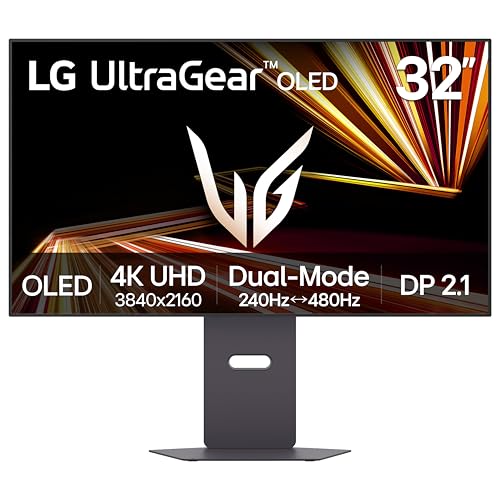 LG UltraGear 32GX870A-BDetails ↓ LG UltraGear 32GX870A-BDetails ↓ | $869.00 | 4.3/5Amazon | Best 4K and esports dual mode |
03 Alienware AW3425DWDetails ↓ Alienware AW3425DWDetails ↓ | $699.99 | 4.5/5Amazon | Best immersive ultrawide |
04 LG UltraGear 27GR83Q-BDetails ↓ LG UltraGear 27GR83Q-BDetails ↓ | $270.22 | 4.3/5Amazon | Best fast IPS for PC and console |
05 ASUS TUF Gaming VG27AQ3ADetails ↓ ASUS TUF Gaming VG27AQ3ADetails ↓ | $179.00 | 4.6/5Amazon | Best lower-cost QHD option |
01 — ASUS
Best 27-inch OLED balanceASUS ROG Strix OLED XG27AQDMG
I would put the XG27AQDMG on a fast QHD PC desk where OLED contrast and 240Hz refresh both earn their keep. Its 26.5-inch viewable glossy panel is easier to place than a 32-inch 4K screen, while still giving dark games the black levels an IPS display cannot reproduce.
It takes first place for that balanced PC use, not for universal compatibility. Its HDMI mode does not deliver the full 240Hz QHD headline, and the OLED panel needs sensible static-image care. The LG 27GR83Q-B is the safer value comparison for long desktop-heavy sessions.
Specifications: Exact Amazon product listing ↗
View on Amazon ↗A QHD PC gamer who values OLED contrast.
You use static desktop tools all day or need 4K.
What I like
+240Hz QHD OLED in a manageable size.
What to weigh
−OLED care and HDMI mode limits.
- Model
- XG27AQDMG
- Panel
- 26.5-inch viewable glossy WOLED
- Resolution
- 2560 x 1440
- Refresh rate
- 240Hz
- Response
- 0.03ms GtG
- Color
- 99% DCI-P3
02 — LG
Best 4K and esports dual modeLG UltraGear 32GX870A-B
The 32GX870A-B makes sense when one PC plays both richly detailed 4K games and fast competitive titles. Its listed dual mode switches from 4K at 240Hz to Full HD at 480Hz, so you are paying for two distinct priorities in one large OLED display.
I rank it behind the ASUS because the price and 31.5-inch footprint are a lot to accept for someone who only needs QHD. The Full HD mode also looks softer at this size. Choose it when your PC and desk genuinely support both modes.
Specifications: Exact Amazon product listing ↗
View on Amazon ↗One high-end PC for 4K and high-speed play.
Your graphics card or budget cannot exploit it.
What I like
+Two useful refresh and resolution modes.
What to weigh
−Premium cost and softer FHD mode.
- Model
- 32GX870A-B
- Panel
- 31.5-inch OLED
- Resolution
- 3840 x 2160
- Dual mode
- 4K 240Hz or FHD 480Hz
- Response
- 0.03ms GtG
- Color
- 98.5% DCI-P3
03 — Alienware
Best immersive ultrawideAlienware AW3425DW
If a wide racing or adventure view matters more than 4K pixel count, I would look at the AW3425DW. Its 34.2-inch 3440-by-1440 QD-OLED panel and 240Hz refresh are a deliberate choice for a compatible 21:9 PC library.
It is third because ultrawide support is not universal: some games and video keep side bars, and a desk must accommodate the width. The 27-inch ASUS is the simpler all-round shape if you also use a console or standard-screen media.
Specifications: Exact Amazon product listing ↗
View on Amazon ↗PC gamers who want a 21:9 field of view.
Your games or video often require 16:9.
What I like
+Wide OLED gaming view.
What to weigh
−Side bars and desk-width demands.
- Model
- AW3425DW
- Panel
- 34.2-inch QD-OLED
- Resolution
- 3440 x 1440
- Aspect ratio
- 21:9
- Refresh rate
- 240Hz
- Curve
- 1800R
04 — LG
Best fast IPS for PC and consoleLG UltraGear 27GR83Q-B
LG’s 27GR83Q-B is the practical alternative for someone who wants QHD, a 240Hz PC ceiling and HDMI 2.1 without paying for OLED. Its IPS panel and adjustable stand make it easier to treat as an everyday work-and-play monitor.
It sits fourth because its HDR400 specification should not be mistaken for OLED black levels. A console is also limited to its supported QHD 120Hz mode, so I would buy it for the combination of inputs and lower ownership fuss rather than an HDR badge.
Specifications: Exact Amazon product listing ↗
View on Amazon ↗Mixed PC, console and everyday desktop use.
You specifically want OLED contrast.
What I like
+Fast QHD IPS with HDMI 2.1.
What to weigh
−Modest HDR contrast versus OLED.
- Model
- 27GR83Q-B
- Panel
- 27-inch IPS
- Resolution
- 2560 x 1440
- PC refresh
- 240Hz
- Console refresh
- Up to 120Hz at QHD
- Inputs
- HDMI 2.1 and DisplayPort 1.4
- Color gamut
- 95% DCI-P3
05 — ASUS
Best lower-cost QHD optionASUS TUF Gaming VG27AQ3A
The VG27AQ3A gets you a 27-inch QHD Fast IPS picture and a listed 180Hz DisplayPort mode without the cost of the OLED models. I would choose it for a midrange PC where a better graphics card matters more than paying extra for a display feature you cannot feed.
It closes the list because the stand lacks height adjustment and its HDMI refresh is lower than the DisplayPort ceiling. Compare a monitor arm and the exact ports on your machine before deciding the cheaper screen is the cheaper complete setup.
Specifications: Exact Amazon product listing ↗
View on Amazon ↗A midrange QHD PC on a tighter budget.
You need built-in height adjustment or OLED.
What I like
+Useful QHD speed for less money.
What to weigh
−Limited stand and input-specific refresh.
- Model
- VG27AQ3A
- Panel
- 27-inch Fast IPS
- Resolution
- 2560 x 1440
- Refresh rate
- 180Hz DisplayPort; 144Hz HDMI
- Console timing
- 2560 x 1440 at 120Hz over HDMI, documented in the exact-model manual
- Inputs
- Two HDMI 2.0; one DisplayPort 1.4
- Stand
- Tilt and swivel; no height adjustment
Price information
Amazon price and availability checked Oct 17, 2026, 10:25 PM Lisbon time. Prices and availability are subject to change; the information shown on Amazon.com at purchase applies.
Our process
How we picked.
We compare five relevant products for different needs, using documented specifications, clear use cases and practical trade-offs. Our goal is to make the differences clear and help you choose with confidence.
- 01Relevance
Each product must fit the guide’s intended use, audience and requirements.
- 02Specifications
We compare the key product details that meaningfully affect the buying decision.
- 03Use case and fit
We compare the intended use, configuration and practical fit of every selected product.
- 04Strengths and limitations
We explain where each option performs best and the compromises to consider.
Good questions
FAQ — Gaming Monitors
01Do I need 4K for a 27-inch gaming monitor?+
QHD can be a more manageable match for a midrange graphics card. Compare the games you play, your viewing distance and the frame rate your computer can sustain.
02Does a 240Hz label guarantee 240Hz from a console?+
No. Check the exact HDMI input, supported console resolution and refresh combinations, and the console’s own output limit.
The short answer
Start with the ASUS ROG Strix OLED XG27AQDMG.
I recommend it for a qhd pc gamer who values oled contrast. Choose something else if you use static desktop tools all day or need 4k.
View on Amazon ↗Keep looking
Related guidesThe 5 Best Gaming Monitors for Xbox Series X
Five Xbox Series X monitors compared by HDMI 2.1, console refresh, resolution and panel trade-offs.
The 5 Best Ultrawide Gaming Monitors
Five Alienware, LG, ASUS, Samsung and CRUA ultrawides for fast OLED gaming, large workspaces and lower-cost LCD.
Best OLED Computer Monitors
Five OLED computer monitors compared by panel size, resolution, refresh, burn-in care and inputs.