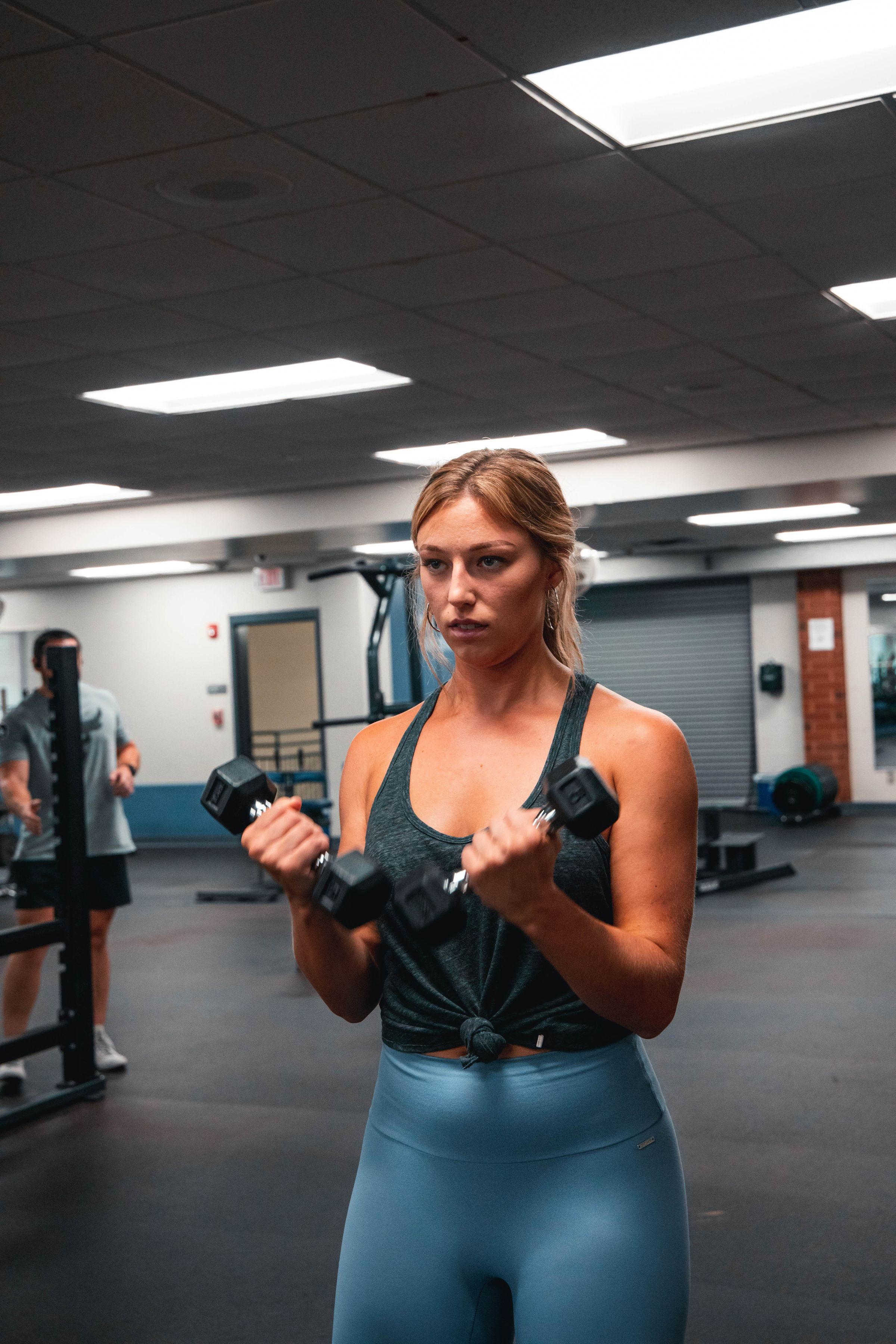
The dumbbell curl is one of the simplest exercises for training the biceps.
It requires little space, minimal equipment and allows each arm to work independently.
However, swinging the weights, moving the elbows excessively or choosing dumbbells that are too heavy can make the exercise less effective.
01
How to do a dumbbell curl
Stand with a dumbbell in each hand and your arms by your sides.
Keep your chest upright and shoulders relaxed.
Bend your elbows and raise the dumbbells toward your shoulders.
Pause briefly near the top, then lower the weights slowly until your arms are extended again.
Keep the movement controlled throughout the repetition.
02
Keep your elbows stable
Your elbows should stay relatively close to your torso.
If they move far forward, other muscles can start contributing more to the movement.
A small amount of natural movement is fine, but avoid deliberately throwing your elbows forward to lift heavier dumbbells.
03
Do not swing the weights
If your torso rocks backward every time you curl, the dumbbells are probably too heavy.
Momentum may allow you to complete the repetition, but it reduces control.
Use a lighter weight and keep your torso stable.
04
Supinated dumbbell curls
This is the standard variation where your palms face upward during the curl.
You can start with the palms facing forward or rotate the hand while lifting.
The biceps help both bend the elbow and rotate the forearm, which is why this movement is so common.
05
Hammer curls
Hammer curls keep the palms facing each other throughout the exercise.
They train the arms differently and place greater emphasis on muscles such as the brachialis and brachioradialis.
Combining standard curls and hammer curls can add variety to an arm workout.
06
Alternating vs simultaneous curls
You can curl both dumbbells at the same time or alternate arms.
Alternating allows you to focus on one side at a time and may make it easier to maintain control.
Simultaneous curls can make the set faster and challenge your ability to keep the torso stable.
Both approaches work.
07
How heavy should dumbbells be for curls?
Choose a weight that lets you perform clean repetitions without swinging.
The correct load varies widely.
For muscle-building work, the final repetitions of a set should feel difficult while still allowing controlled technique.
If you need several different weights, see our guide to the best adjustable dumbbells.
08
How many curls should you do?
There is no single ideal number.
Moderate-repetition sets are commonly used, but total weekly training volume matters more than one specific rep range.
Avoid performing endless curl variations if your broader workouts already include pulling exercises.
09
Practical checks before you continue
Set your stance before the first repetition: feet stable, ribs controlled and shoulders relaxed. Curl without turning the movement into a hip drive. If the torso rocks, the load is too heavy for the intended exercise or the set has continued past useful form.
A supinated curl emphasizes the classic palms-up position, while a neutral hammer grip changes forearm involvement and can feel more comfortable for some wrists. Neither variation needs to replace the other. Use a range that remains pain free and repeatable.
Choose a weight that allows the final repetitions to slow without the elbows traveling far forward. Small increments help because arm exercises often progress more slowly than leg movements. Our dumbbells for home guide includes compact choices.
Train both arms through the same deliberate range, but do not force identical loads if an injury or marked strength difference exists. Our broader dumbbell arm exercise guide shows how curls fit alongside triceps and shoulder work.
Alternating curls can make it easier to focus on one arm, while simultaneous curls save time. Neither is automatically superior. Keep the non-working arm controlled, avoid resting between every repetition and stop before grip fatigue changes wrist position. For equipment with smaller weight jumps, see adjustable dumbbells for home workouts.
Sources and further reading
We use primary and specialist sources to check the principles in this article. Product recommendations are researched separately.
