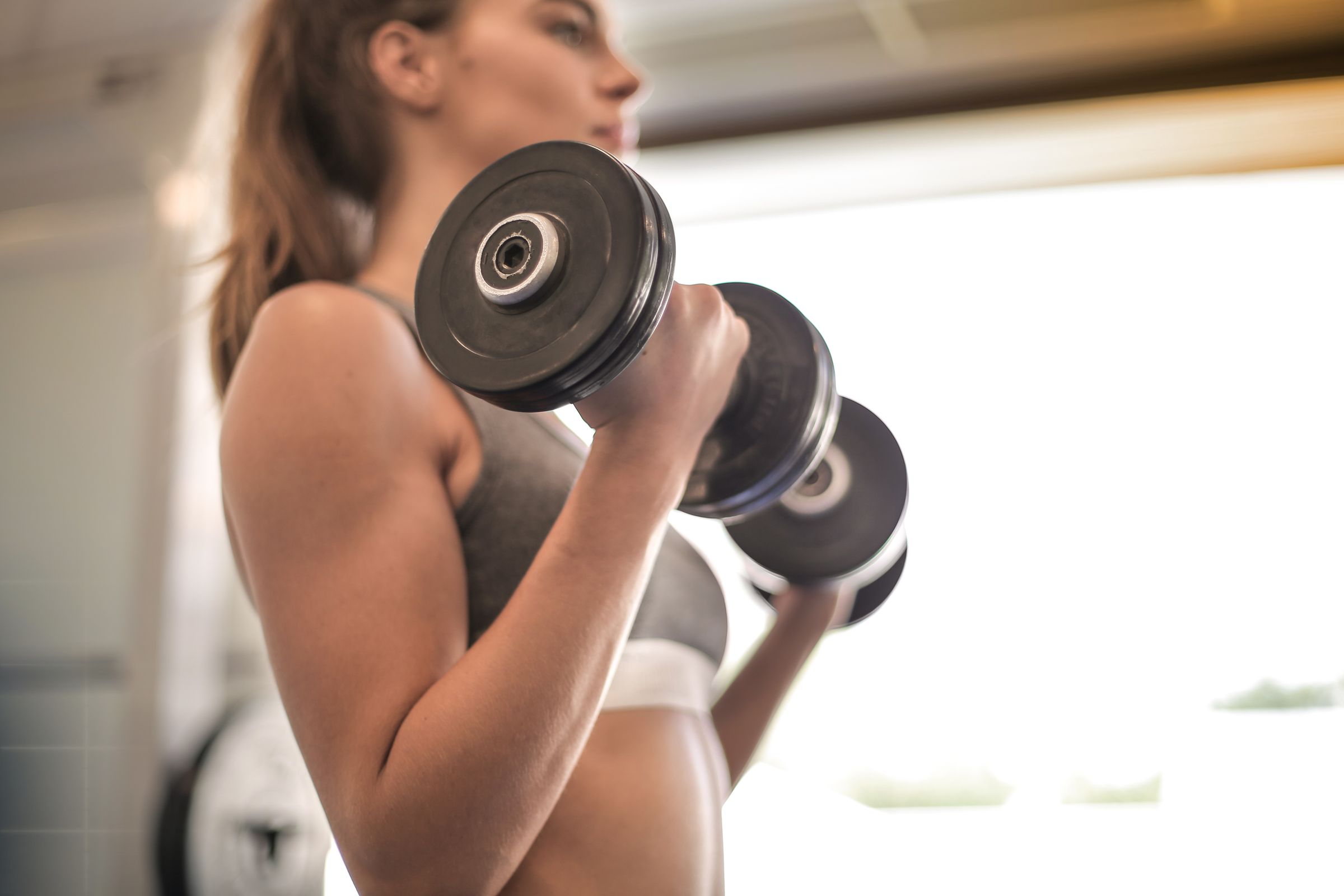
A pair of dumbbells is enough to train both the biceps and triceps without needing a cable machine or large home gym.
The best arm workouts usually include a combination of curling and extension movements rather than performing dozens of similar exercises.
Here are several useful options.
01
Standard dumbbell curl
Hold a dumbbell in each hand and curl the weights toward your shoulders.
Keep your elbows close to your sides and avoid swinging your torso.
Lower the weights slowly.
This is one of the simplest ways to directly train the biceps.
02
Hammer curl
Keep your palms facing each other throughout the movement.
Curl the dumbbells toward your shoulders while keeping your wrists neutral.
Hammer curls work the elbow flexors from a slightly different angle than standard curls.
03
Incline dumbbell curl
Sit on an incline bench with your arms hanging down.
Curl the dumbbells without allowing your shoulders to move forward excessively.
The extended starting position makes this variation feel different from standing curls.
04
Overhead triceps extension
Hold one dumbbell with both hands above your head.
Bend your elbows and lower the dumbbell behind your head.
Extend your elbows to return to the starting position.
Keep the upper arms relatively stable.
05
Dumbbell skull crusher
Lie on a bench or the floor with dumbbells above your chest.
Bend your elbows to lower the weights toward either side of your head, then extend the arms.
Use light enough weights to maintain control.
06
Dumbbell kickback
Lean forward and keep the upper arm close to your torso.
Extend the elbow until the arm straightens behind you.
Kickbacks usually work best with relatively light weights and strict technique.
07
Close-grip dumbbell press
Lie on a bench or floor and hold two dumbbells close together above your chest.
Lower them while keeping your elbows relatively close to the body, then press upward.
This is a compound exercise that places more emphasis on the triceps than a wider press.
08
How to structure a dumbbell arm workout
You do not need every exercise in one session.
A simple workout might include:
- standard curl
- hammer curl
- overhead triceps extension
- close-grip dumbbell press
Choose two biceps and two triceps exercises and focus on controlled repetitions.
If you train at home, our dumbbell recommendations can help you choose suitable equipment.
09
Practical checks before you continue
A balanced session should not be ten versions of the same curl. Combine one biceps movement, one triceps movement and, if appropriate, a press or raise. Compound exercises can come first while you are fresh, followed by smaller isolation movements.
Two or three controlled working sets per exercise are enough for a simple starting plan. Rest long enough to repeat good form and keep the wrist stacked. Our biceps curl form guide explains elbow position and load selection in more detail.
Use progressive overload gradually: add a repetition within your target range, then increase weight when every set is controlled. Adjustable pairs can make this easier; see our adjustable dumbbell guide for increment and storage tradeoffs.
Leave recovery between sessions that train the same muscles hard. Shoulder or elbow pain is not something to push through. If a movement causes sharp pain, numbness or loss of control, stop and seek individual guidance. Our dumbbell shoulder guide covers common raise and press cues.
A simple order is shoulder press, one curl, one triceps extension and an optional lateral raise. Start with the movement requiring the most coordination, then use lighter exercises. Choose variations that remain comfortable rather than adding every exercise to one session.
Keep dumbbells away from the edge of benches and return them to the floor with a controlled hinge or squat. For limited rooms, compare adjustable dumbbells for small spaces. Secure every selector before beginning the next set.
Alternate training days with recovery, walking or lower-body work rather than repeating hard arm sessions daily. Consistent weekly practice matters more than exhausting one workout.
Sources and further reading
We use primary and specialist sources to check the principles in this article. Product recommendations are researched separately.
