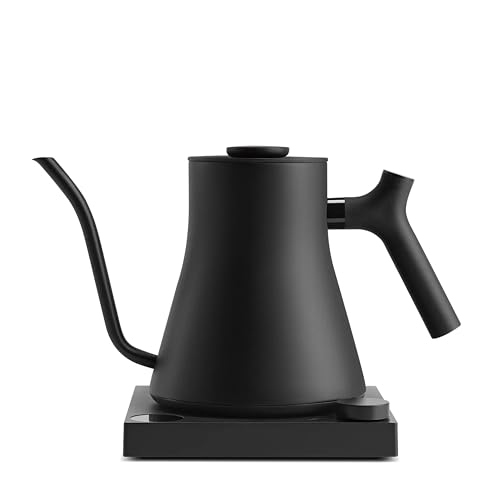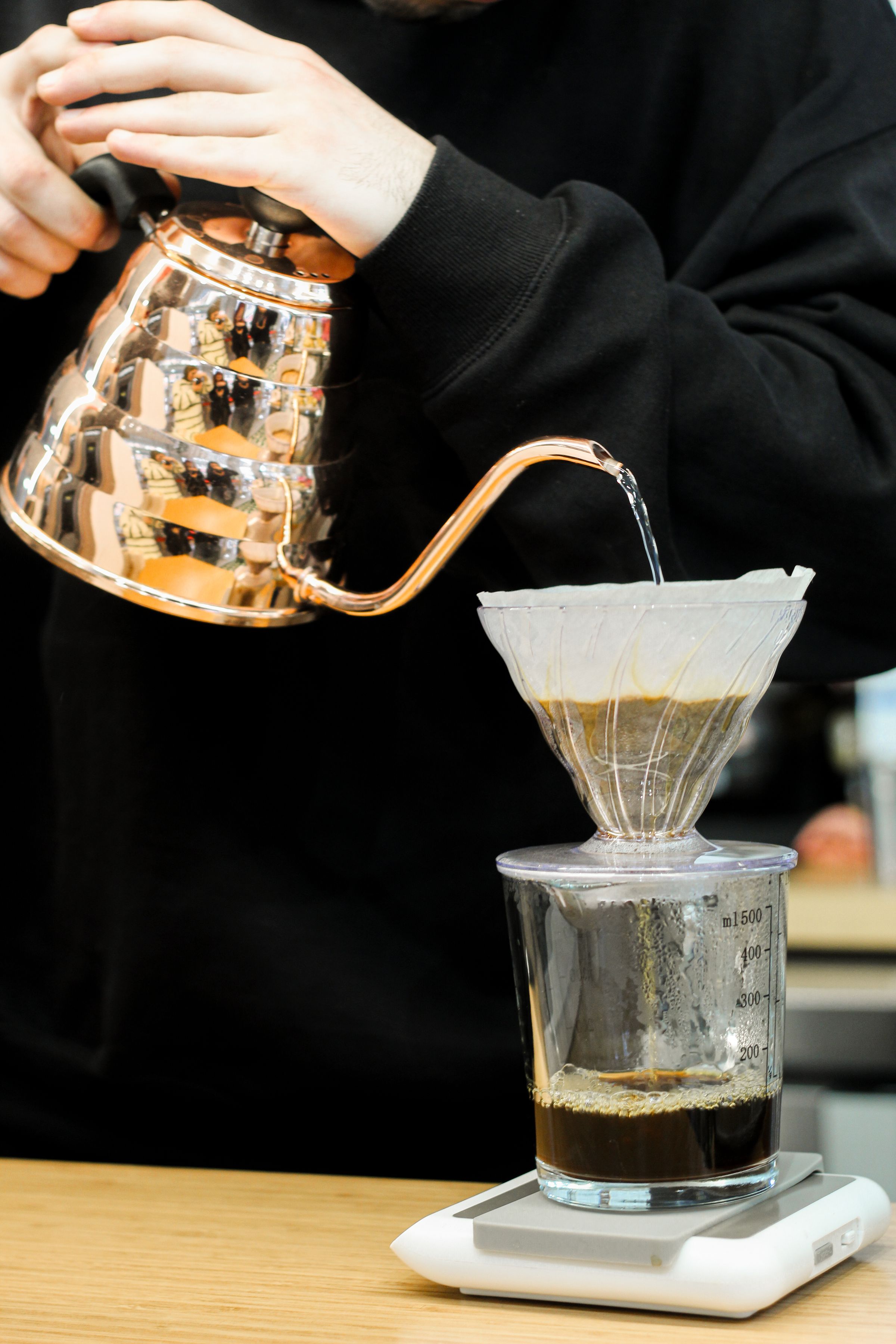
A gooseneck kettle has a long, narrow spout designed to give you much more control over how quickly and accurately water is poured.
That control is particularly useful for pour-over coffee, where water distribution can affect extraction and ultimately the taste of the cup.
You can make pour-over coffee without one, but a gooseneck kettle makes the process considerably easier.
01
Better control over water flow
The biggest advantage is flow rate.
A normal kettle has a wide spout that can release a large amount of water quickly. That is useful for filling cups, but less suitable when you need a slow, controlled pour.
A gooseneck spout lets you pour a thin and consistent stream.
This makes it easier to control how quickly the coffee bed becomes saturated.
02
More accurate pouring
Pour-over methods usually involve moving water around the coffee bed rather than pouring everything into one spot.
The narrow spout helps you aim accurately.
You can pour near the center, move outward in circles and avoid pouring directly against the paper filter.
Better control does not automatically guarantee better coffee, but it makes your technique more repeatable.
03
Easier coffee blooming
The bloom is the initial stage where a small quantity of hot water is added to freshly ground coffee.
This allows trapped gases to escape before the main pour.
A gooseneck kettle makes it easier to add just enough water to wet the grounds without flooding them.
04
Electric vs stovetop gooseneck kettles
Stovetop models are simple and usually cheaper.
Electric gooseneck kettles offer additional convenience and may include temperature control.
Adjustable temperature is useful if you brew different coffee styles or teas.
Some models can also hold the selected temperature for several minutes.
If you are deciding between models, see our guide to the best electric gooseneck kettles.
05
Does a gooseneck kettle improve coffee?
It does not improve the coffee by itself.
The real advantage is consistency.
Because you can control the flow and placement of water more precisely, it becomes easier to repeat the same brewing method each morning.
Coffee quality still depends on your beans, grind size, water temperature, ratio and brewing technique.
06
Do beginners need one?
Not necessarily.
You can start making pour-over coffee using a regular kettle.
However, if pour-over becomes part of your normal routine, a gooseneck kettle is one of the most useful upgrades because it directly improves your control over brewing.
07
Temperature control matters too
For coffee brewing, water temperature can affect extraction.
An electric kettle with adjustable temperature gives you more control than simply boiling water and waiting.
If you frequently switch between coffee and tea, variable temperature settings become even more useful.
08
A practical way to decide
A gooseneck helps most when you use it with a repeatable recipe. Weigh the coffee and water, keep the grind consistent, and note the total brew time. The kettle controls where water lands, but it cannot correct an unsuitable grind or an uneven coffee bed by itself.
Start with a gentle bloom that wets all the grounds, then pour in controlled pulses or one steady stream according to the brewer and recipe. Keep the water level reasonably stable and avoid striking the paper filter continuously. A scale makes these small changes visible; our espresso scale guide includes compact models useful for manual brewing too.
Temperature control is convenient when you move between coffees, but it is only one variable. Freshness, dose, grind and pouring technique often create larger changes in the cup. Use the brewer or roaster's recommended range as a starting point, then change one variable at a time rather than chasing an exact number.
If a brew drains too quickly or tastes thin, a finer grind may help; if it stalls or tastes harsh, try coarser. The principles in our coffee grind size chart provide a useful reference. For espresso-specific adjustments, see espresso grind size.
Sources and further reading
We use primary and specialist sources to check the principles in this article. Product recommendations are researched separately.