The 5 Best Programming Desktop PCs
A programming desktop does not need a gaming graphics card to feel fast. It needs enough memory for your editor, browser and local services, storage that is not full after the first project, and ports that fit the displays you actually use. Container-heavy work changes the answer; so does a desk where the computer must disappear behind a monitor.
I would start with the GEEKOM A7 for a compact machine that arrives with 32 GB of memory. GMKtec M7 Ultra makes more sense if USB4 and external expansion drive the setup. The expensive GT13 MAX is for heavier local workloads, while KAMRUI AK1PLUS is a budget desk companion for learning and light web work. Check your operating-system and virtualization requirements before ordering any mini PC.
Our top 5 programming desktop pcs
Swipe to compare price, rating and best use →
| Product | Price | Rating | Best for |
|---|---|---|---|
01 GEEKOM A7Details ↓ GEEKOM A7Details ↓ | $699.00 | 4.3/5Amazon | Best balanced development desk |
02 GMKtec M7 UltraDetails ↓ GMKtec M7 UltraDetails ↓ | $559.99 | 4.4/5Amazon | Best for external expansion |
03 GEEKOM GT13 MAXDetails ↓ GEEKOM GT13 MAXDetails ↓ | $849.00 | 4.4/5Amazon | Best heavier local workloads |
04 GMKtec M2 ProDetails ↓ GMKtec M2 ProDetails ↓ | $499.98 | 4.3/5Amazon | Best established Intel value |
05 KAMRUI AK1PLUSDetails ↓ KAMRUI AK1PLUSDetails ↓ | $349.99 | 4.4/5Amazon | Best compact starter PC |
01 — GEEKOM
Best balanced development deskGEEKOM A7
This A7 offer pairs a Ryzen 7 7730U with 32 GB of RAM and a 500 GB SSD in a mini PC. The memory headroom is useful when an editor, browser and a few local services stay open together. Storage is modest for large virtual-machine images, so plan an upgrade or external drive if those are routine.
First because 32 GB out of the box solves a more common development bottleneck than a headline GPU. M7 Ultra has better specialized expansion and GT13 MAX a higher-end processor, but A7 is the easier starting value for a working desk.
Specifications: Exact Amazon product listing ↗
View on Amazon ↗Editors plus local services.
You store many large VM images.
What I like
+32 GB installed in a small box.
What to weigh
−500 GB storage may fill quickly.
- Processor
- AMD Ryzen 7 7730U
- Memory
- 32GB RAM
- Storage
- 500GB SSD
- Connectivity
- USB-C, HDMI, 2.5Gb Ethernet
- Operating system
- Windows
02 — GMKtec
Best for external expansionGMKtec M7 Ultra
The M7 Ultra listing combines Ryzen 7 PRO 6850U, 16 GB DDR5, dual USB4 and an OCuLink port. Those connectors matter if a developer uses fast external storage, several displays or a planned external graphics setup. The 16 GB starting memory is less generous than the A7's 32 GB.
Second for a desk built around ports and future expansion. I would choose A7 for ordinary software work where installed RAM matters today. M7 Ultra earns its higher slot over the older M2 Pro because its connection choices are more useful for specialized setups.
Specifications: Exact Amazon product listing ↗
View on Amazon ↗Fast external devices and many displays.
You want 32 GB installed immediately.
What I like
+USB4 and OCuLink connection options.
What to weigh
−Starts with 16 GB RAM.
- Processor
- AMD Ryzen 7 PRO 6850U
- Memory
- 16GB DDR5
- Storage
- 512GB SSD
- Connectivity
- USB4, HDMI, OCuLink, dual 2.5Gb Ethernet
- Operating system
- Windows
03 — GEEKOM
Best heavier local workloadsGEEKOM GT13 MAX
GT13 MAX brings an Intel Core Ultra 9 185H, 16 GB DDR5 and a 1 TB SSD to a compact desktop. The processor and storage make it a candidate for larger builds and local projects, but the exact RAM configuration still needs attention before container-heavy work. It is also the costliest mini PC in this set.
Third because extra CPU headroom is valuable only when your build and local services actually use it. I would buy A7 first for a balanced desk, then consider GT13 MAX if the workload is demonstrably heavier and a memory upgrade is in the plan.
Specifications: Exact Amazon product listing ↗
View on Amazon ↗Large builds and local projects.
Your work is mainly browser and editor.
What I like
+High-end CPU with 1 TB SSD.
What to weigh
−High price with 16 GB starting RAM.
- Processor
- Intel Core Ultra 9 185H
- Memory
- 16GB DDR5
- Storage
- 1TB SSD
- Connectivity
- USB4, HDMI and Mini DisplayPort
- Operating system
- Windows
04 — GMKtec
Best established Intel valueGMKtec M2 Pro
M2 Pro is an older Core i7-1185G7 mini PC with 16 GB DDR4, a 1 TB SSD and 2.5 GbE in this exact listing. It gives a buyer ample local storage and fast wired networking without paying for the newest processor label. Check the included memory layout before planning an upgrade.
Fourth for someone whose dev environment values local files and wired networking more than peak build speed. A7 wins for installed memory, and M7 Ultra for newer expansion ports; M2 Pro makes sense when those differences matter less than its current price.
Specifications: Exact Amazon product listing ↗
View on Amazon ↗Storage-heavy work on wired LAN.
You need newer CPU headroom.
What I like
+1 TB SSD and 2.5 GbE.
What to weigh
−Older processor and DDR4.
- Processor
- Intel Core i7-1185G7
- Memory
- 16GB DDR4
- Storage
- 1TB SSD
- Connectivity
- Dual HDMI, USB-C, 2.5Gb Ethernet
- Operating system
- Windows
05 — KAMRUI
Best compact starter PCKAMRUI AK1PLUS
KAMRUI AK1PLUS combines a Celeron N5095, 16 GB memory and a 256 GB SSD in a small desktop. It can handle coding lessons, an editor and basic web projects without taking much desk space. That older low-power processor is the decisive limit: large builds and several running containers need a stronger machine.
Fifth because it gives a low-cost entry point for a clearly lighter kind of development work. I would pay for A7 if local databases, virtual machines or frequent builds are already part of the routine. Choose AK1PLUS when learning and a small desk are the priority, and budget for a better machine as the projects grow.
Specifications: Exact Amazon product listing ↗
View on Amazon ↗Learning and light web work.
You compile large projects locally.
What I like
+Low-cost 16 GB mini desktop.
What to weigh
−Older low-power CPU and 256 GB SSD.
- ProductType
- Computers
Price information
Amazon price and availability checked Oct 17, 2026, 9:54 PM Lisbon time. Prices and availability are subject to change; the information shown on Amazon.com at purchase applies.
Our process
How we picked.
We compare five relevant products for different needs, using documented specifications, clear use cases and practical trade-offs. Our goal is to make the differences clear and help you choose with confidence.
- 01Relevance
Each product must fit the guide’s intended use, audience and requirements.
- 02Specifications
We compare the key product details that meaningfully affect the buying decision.
- 03Use case and fit
We compare the intended use, configuration and practical fit of every selected product.
- 04Strengths and limitations
We explain where each option performs best and the compromises to consider.
Good questions
FAQ — Programming Desktop PCs
01How much RAM should a programming PC have?+
Start from the editor, browser, containers and local databases you run together. A 16 GB machine may suffice for lighter work; heavier parallel services can justify 32 GB or expandable memory.
02Do these mini PCs include a monitor?+
No. Budget for the display, keyboard, mouse and any dock or adapter required by your actual ports.
The short answer
Start with the GEEKOM A7.
I recommend it for editors plus local services. Choose something else if you store many large vm images.
View on Amazon ↗Keep looking
Related guidesThe 5 Best Compact Desktops for Photo Editing
Five GEEKOM, GMKtec and Apple mini desktops for large RAW catalogs, local project storage, external SSDs and macOS editing.
The 5 Best Mini PCs
Five Windows mini PCs, compared by processor, memory, storage and ports for everyday desktop work.
The 5 Best Mini PCs for a Home Office
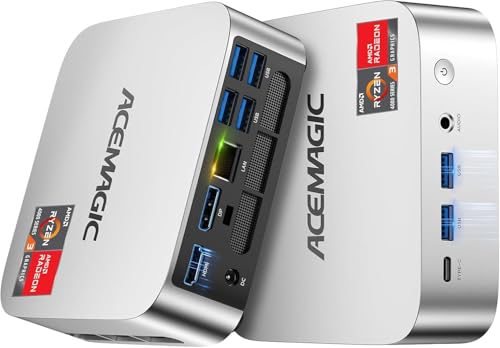
Five ACEMAGIC, GMKtec and GEEKOM mini PCs for cloud documents, local files, three monitors and heavier multitasking.