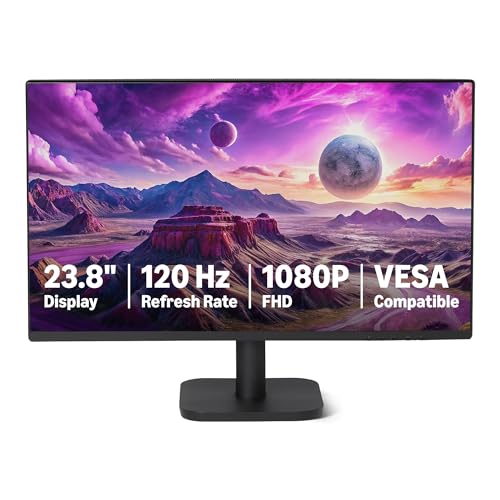
Monitor resolution describes how many pixels a display uses to create the image on screen.
A resolution of 1920 × 1080, for example, means the display contains 1,920 pixels horizontally and 1,080 vertically.
Higher resolutions generally provide more detail, but resolution alone does not determine how sharp a monitor looks.
Screen size, viewing distance and pixel density also matter.
01
What is 1080p?
1080p, also known as Full HD, has a resolution of 1920 × 1080.
It remains common on smaller monitors and budget gaming displays.
At around 24 inches, 1080p can still look reasonably sharp for everyday use.
On larger screens, individual pixels become more noticeable.
02
What is 1440p?
1440p normally refers to 2560 × 1440.
It provides significantly more workspace and detail than 1080p.
For 27-inch monitors, 1440p is a popular balance between sharpness, price and graphics performance.
Games also require less GPU power at 1440p than at 4K.
03
What is 4K?
A typical 4K computer monitor has a resolution of 3840 × 2160.
That is four times the total pixel count of 1080p.
4K is especially useful for larger monitors, detailed creative work and users who want very sharp text.
However, operating-system scaling may be necessary because interface elements can appear very small at native size.
04
Does higher resolution always look better?
Not automatically.
A 4K resolution on a small display can provide extremely high pixel density, but you may need to increase scaling.
Meanwhile, a very large 1080p monitor can look noticeably less sharp because the pixels are spread across a larger area.
The relationship between screen size and resolution matters more than either specification alone.
05
Resolution vs refresh rate
Resolution determines image detail.
Refresh rate determines how many times the display can update each second.
A 4K 60 Hz monitor offers more detail than a 1080p 144 Hz monitor, but the 144 Hz display can show smoother motion.
Which matters more depends on what you do.
Gamers may prioritize refresh rate, while photographers or productivity users may prefer additional resolution.
06
What resolution is best for a 24-inch monitor?
1080p is still common at 24 inches.
1440p provides additional sharpness but is less common in that size.
For basic office use and gaming, 1080p can remain perfectly practical.
07
What resolution is best for a 27-inch monitor?
1440p is a strong general-purpose choice.
4K provides noticeably higher pixel density, particularly for text and detailed work.
Your graphics hardware and budget should also influence the decision.
If you are choosing a new screen, see our computer monitor recommendations.
08
Practical checks before you continue
Resolution is only one part of perceived sharpness. The same 3840 by 2160 image looks denser on a 27-inch panel than on a much larger screen because the pixels are packed closer together. Viewing distance and eyesight also change what feels comfortable.
Operating-system scaling enlarges text and controls while preserving native pixel detail. It is preferable to lowering the display resolution for readability. If text already looks soft, work through our blurry monitor guide before buying a higher-resolution display.
More pixels require more graphics bandwidth. For office work, confirm that the computer, cable, hub and port support the target resolution and refresh rate. For games, higher resolution can reduce frame rate, so balance detail against motion using our gaming monitor guide.
Choose size and resolution together, then check scaling support in the applications you use. A 4K computer monitor provides workspace and detail, but a well-scaled 1440p screen may be the more practical match for a modest computer or smaller desk.
Text size should be comfortable without leaning toward the screen. If 4K requires extreme scaling in your favorite applications, test their behavior before committing. Our home-office monitor guide provides practical size and connectivity comparisons alongside resolution.
Also check the native resolution of a laptop panel and every external screen separately. Mixed-density setups may need different scaling percentages to keep text comfortable.
Sources and further reading
We use primary and specialist sources to check the principles in this article. Product recommendations are researched separately.